

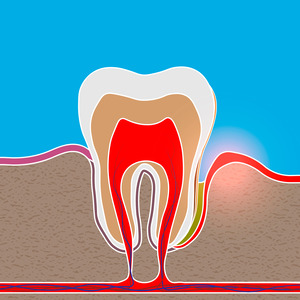
When your dentist diagnoses your gum disease, they may tell you that periodontal pockets have formed. If you haven’t heard this term before, you may be wondering what a periodontal pocket is and what kind of impact it can have on the health of your smile. Below is an overview of what you need to know about this advanced gum disease symptom and your options for treating it.
Periodontal Pockets: What are They?
A periodontal pocket is an opening between your teeth and your gumline. In a healthy mouth, these spaces are only about 1 to 3 millimeters deep. But when you have gum disease, the gum tissue starts to pull away from the teeth. This causes your periodontal pockets to increase in size. A pocket depth of 4 millimeters or greater is typically a warning sign of periodontitis, which is the advanced form of gum disease; the deeper the pocket, the more severe your periodontitis is.
Over time, harmful bacteria can build up in your periodontal pockets. This can make your gum disease even worse. Furthermore, a large periodontal pocket is a sign that the tissues holding your teeth in place have suffered from significant damage. In other words, you could be at risk of losing your teeth if nothing is done about the issue.
How Can Periodontal Pockets Be Treated?
Before periodontal pockets can be treated, they need to be diagnosed. During a routine checkup, your dentist can look for spaces between your teeth and gums. By measuring the depth of any pockets they find, they can determine whether gum disease is present and how advanced it is.
After considering the specifics of your situation, your dentist will explain what options are available for treating your periodontal pockets. Depending on the severity of your gum disease, you may need to undergo a deep cleaning procedure that consists of scaling and root planing.
During scaling, the pockets are thoroughly cleaned from top to bottom in order to get rid of any plaque and tartar that has built up over time. Once scaling is complete, your dentist moves on to root planing, which involves smoothing out the roots of the teeth. Not only does this discourage future bacterial buildup, but it also makes it easier for the gums to reattach to the teeth.
If periodontal pockets are found in your mouth, you can’t afford to ignore the problem. It’s best to seek the right form of treatment as quickly as possible so that you can restore and protect the health of your teeth and gums.
About the Author
Dr. Bikram Singh earned a Bachelor of Dental Surgery in India. After moving to the United States, he studied at the University of Pennsylvania School of Dental Medicine. To this day, he keeps up with the latest advancements in dentistry via continuing education. At Cary Dental Rejuvenation, he offers scaling and root planing as a solution for gum disease. If you’re concerned about your gum health, you can schedule an appointment with Dr. Singh by visiting his website, using his online scheduling tool, or calling (919) 460-5454.